
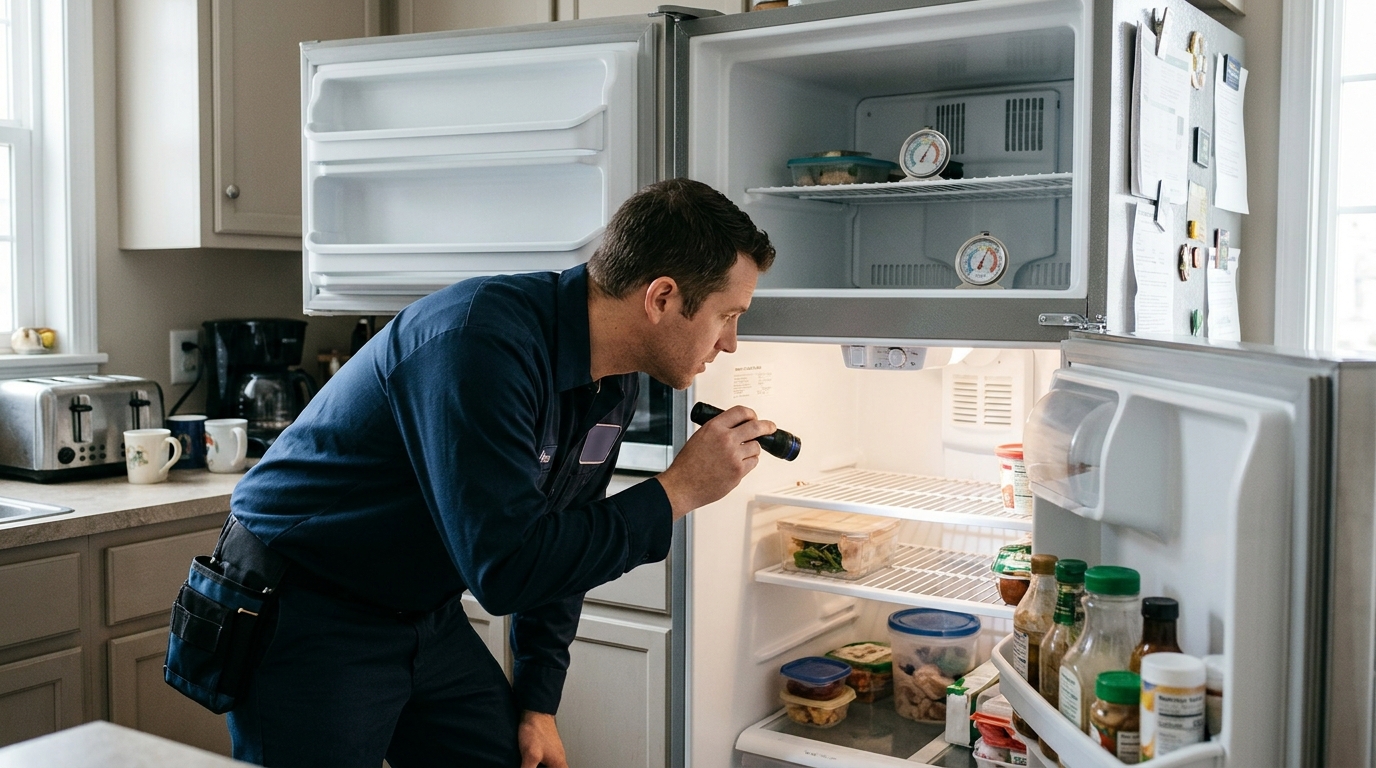
Open the door, feel warm air and see the milk getting soft. Then you check the freezer and the ice cream is still solid. A refrigerator not cooling but freezer works situation is confusing, but it points to a specific kind of problem. In most cases, the cooling system is making cold air, and that air is not reaching the fresh food section.
This guide explains why it happens, which parts fail most often and which checks you can do safely at home. You will also learn when to stop and call a technician for fridge repair in Tucson.
Quick Answer: What Causes a Fridge Warm and a Freezer Cold?
When a fridge is not cooling but the freezer works, the usual cause is an airflow problem. Most modern refrigerators make cold air in the freezer and send a share of it into the fridge through a vent. A frozen evaporator coil, a failed evaporator fan, a stuck air damper or a bad temperature sensor can block that flow. The compressor often keeps running, so the freezer stays cold.
How the Fridge and Freezer Share Cold Air
Most side by side, top freezer and bottom freezer models use one cooling system. The evaporator coil sits behind a panel in the freezer. A fan pulls air across the coil, and that air gets cold.
Some of the cold air goes into the freezer. The rest travels through a duct to the fresh food section. A small door called a damper opens and closes to control how much air passes through, based on a sensor reading.
Because the freezer sits right next to the coil, it keeps cooling even when the path to the fridge is blocked. The fresh food section sits at the end of the line, so it warms up first. That is why a refrigerator not cooling but freezer works is such a common pairing of symptoms.
Common Causes When the Refrigerator Is Warm but the Freezer Is Cold
1. Frozen Evaporator Coil and Defrost Failure
The coil frosts over during normal use. A defrost system, made of a heater, a thermostat and a timer or control board, melts the frost on a schedule. If one of those parts fails, frost builds up until it blocks airflow.
Signs include a thick layer of frost on the back panel of the freezer, a freezer that cools but a fridge that warms, and water that appears after the ice melts. This is one of the top reasons for a refrigerator not cooling but freezer works.
2. Evaporator Fan Motor Failure
The evaporator fan moves cold air from the coil into both sections. When the motor fails, the freezer may stay cool for a while from the coil alone, but little air reaches the fridge.
Listen for the fan when you open the freezer door. A fan that is silent, noisy or slow can point to a worn motor, ice on the blades or a loose wire.
3. Stuck or Broken Air Damper
The damper controls the airflow to the fresh food section. It can stick closed, freeze shut or lose power. The result is a freezer that stays cold and a fridge that slowly warms.
If you see the fridge vent covered in ice or blocked by a food item, the damper may not be moving freely.
4. Blocked Vents or an Overpacked Fridge
Sometimes the cause is simple. Food or containers pushed against the vent openings block the cold air. A packed freezer can also keep air from circulating.
Blocked airflow can make a perfectly healthy fridge act as though it is failing. It is the easiest cause to check and fix.
5. Faulty Temperature Sensor or Thermistor
The fridge uses a sensor to tell the control board when to send more cold air. If the sensor reads incorrectly, the board may think the fridge is cold enough and keep the damper closed or the fan off.
A bad sensor can cause temperatures that swing up and down or a fridge that stays warm even though the settings look correct.
6. Failed Control Board
The main control board manages the fan, the damper and the defrost cycle. A failure can cut power or send the wrong signal to one of those parts. Control board problems are less common than frost or fan issues, and they are harder to confirm without testing tools.
7. Door Gasket and Door Problems
A worn or torn gasket lets warm room air leak in. This usually affects both sections, but a gasket issue in the fresh food door can overwhelm that section while the freezer holds on. Doors that do not close fully have the same effect.
Check that the door seals evenly and that nothing, such as a shelf or bin, keeps it from closing.
What About Dirty Condenser Coils or a Bad Compressor?
Dirty condenser coils or a failing compressor and sealed system usually lower cooling in both sections, not just the fridge. If your freezer is also warm, or the unit runs constantly without ever getting cold, the issue is more likely in that group. A technician should handle sealed system work.
Quick Checks You Can Do Safely
Try these steps in order. Stop if you smell burning, see sparks or find water near electrical parts.
- Check the temperature settings. Make sure the fridge dial or display has not been bumped or set too warm.
- Look at the vents. Clear any food or containers from the vents in both sections.
- Reduce the load. Move packed items so air can move around them.
- Check the door seals. Close the door on a strip of paper. If it slides out easily, the gasket may need repair.
- Listen for the fan. With the freezer door open, press the door switch and listen for the fan. Silence can point to a fan problem.
- Look for frost. If your model allows safe access to the back panel, check for heavy frost. Do not chip at it with a knife or ice pick, because you can puncture refrigerant lines.
- Do a manual defrost. Unplug the refrigerator, move food into coolers and leave the doors open for several hours so the ice melts. Wipe up water, plug the unit back in and watch whether the fridge cools within a day. If the problem returns in days or weeks, a defrost part has likely failed.
Always unplug the unit before touching any panel, wire or part.
Symptom Guide: What Your Fridge Is Telling You
| What you notice | Likely cause |
|---|---|
| Heavy frost on the back wall of the freezer | Defrost system failure |
| Fan silent or noisy | Evaporator fan motor |
| Vent iced over or blocked | Damper or blocked vent |
| Temperatures swing up and down | Faulty sensor |
| Nothing responds or settings reset | Control board |
| Both sections warm | Condenser, compressor or sealed system |
This table gives a starting point. A technician can confirm the cause with testing.
Food Safety When Your Fridge Is Warm
Cold food safety rules are strict for a reason. Fridge food should stay at or below 40°F. Perishable food that has been above that temperature for more than two hours should not be eaten, and the window drops to one hour when the room is above 90°F, which is easy to reach in a Tucson summer.
Move milk, meat, eggs and leftovers into the freezer or a cooler with ice while you troubleshoot. Use a thermometer rather than guessing. When in doubt, throw it out.
When to Call a Technician
Call for help if:
- The fridge is still warm after you clear the vents and run a manual defrost.
- Frost returns within days or weeks.
- The fan is not running or makes grinding sounds.
- You suspect a bad sensor, damper or control board.
- Both sections are warm or the compressor runs nonstop.
- You see water leaking around electrical parts.
A technician can test the defrost heater, the fan, the damper and the sensor, and then fix the exact part instead of replacing parts by guesswork. If you need fridge repair in Tucson, our fridge repair in Tucson team can diagnose the cause and give you a clear estimate before work begins.
Repair or Replace?
Many causes of a fridge not cooling while the freezer works are repairable, especially fans, defrost parts, sensors and dampers. Replacement becomes worth considering when the refrigerator is old, parts are hard to find or the repair cost is high compared to the unit’s value. Ask your technician to compare the repair estimate with the age and condition of the refrigerator before you decide.
How to Prevent This Problem
- Keep air vents clear and avoid overpacking.
- Do not leave doors open for long periods.
- Clean door gaskets and replace them when they wear.
- Vacuum the condenser coils on a regular schedule.
- Set the fridge and freezer to the recommended temperatures.
- Do not ignore early signs such as frost, odd noises or temperature swings.
Frequently Asked Questions
1. Why is my refrigerator not cooling but the freezer works?
Most often, cold air is not reaching the fresh food section. A frozen evaporator coil, a failed evaporator fan, a stuck damper or a faulty sensor usually causes the blockage. Check the vents and look for frost first.
2. Can a fridge not cooling but freezer works fix itself?
Sometimes a manual defrost clears the problem for a while, but the cause remains. If frost returns, a defrost heater, thermostat or control board likely needs repair.
3. How long does a manual defrost take?
Plan on several hours with the unit unplugged and the doors open, and sometimes up to a day for heavy ice. Keep your food cold in coolers during that time.
4. Is it safe to keep food in the fridge if it is warm?
Food above 40°F for more than two hours is not safe. Move perishables to the freezer or a cooler and check them with a thermometer.
5. What is the most common repair for this problem?
Defrost system failures and evaporator fan motor problems are among the most common. A technician can confirm which one applies to your model.
6. Could a dirty condenser coil cause only the fridge to warm?
It usually affects both sections. Dirty coils are still worth cleaning, because they make the whole system work harder.
7. Should I turn the temperature dial colder?
It rarely solves an airflow problem and can freeze the food near the vent. Fix the cause before changing settings.
8. Does a refrigerator not cooling but freezer works mean the compressor is bad?
Not usually. If the freezer is cold, the compressor is probably working. The issue often lies in the airflow path to the fridge.
9. How much does fridge repair in Tucson cost?
Cost depends on the part, the model and the labor. A written estimate before work starts lets you compare repair with replacement.
10. When should I replace the refrigerator instead?
Consider replacement if the unit is old, repairs are frequent or the cost is high relative to its value. A technician can help you compare both options.
Get Help With a Warm Fridge
If your refrigerator is not cooling but the freezer works, quick action protects your food and often keeps the repair simple. Start with the safe checks above, and book a fridge repair in Tucson visit if the problem continues.