
You walk into the kitchen at night and hear the same hum you heard all afternoon. The motor never seems to rest, and the back of the fridge feels warm. A fridge running constantly is not always a failure, but it can mean the unit is working too hard to keep cool, which wastes power and wears out parts.
This guide explains what normal run time looks like, the most common reasons a fridge never shuts off, and the checks you can do safely at home. It also shows when it is time to book fridge repair in Tucson.
Quick Answer: Why Is My Fridge Running Nonstop?
A fridge running constantly usually has one of four causes. Dirty condenser coils trap heat. Door seals leak warm air inside. A fan stops moving air across the coils. Or a part such as a sensor, relay or compressor fails and the fridge cannot reach its set temperature. Start with the coils and the door seals, because they are the easiest to check.
What Is Normal Run Time for a Refrigerator?
A refrigerator is built to cycle on and off. The compressor runs until the inside reaches the set temperature, then rests, then starts again when the temperature rises.
Run time changes with the room. A kitchen in a Tucson summer, a fridge in a hot garage or a unit filled with groceries will run longer than a unit in a cool room. Many newer models also use variable speed compressors, which run at a low speed for long periods and sound steady.
So a fridge that runs often is not automatically broken. The warning signs are a unit that runs without any breaks for many hours, feels very hot on the sides or back, makes new noises or struggles to stay cold.
Common Reasons for a Fridge Running Constantly
1. Dirty Condenser Coils
The condenser coils release heat from the cooling system. When dust and pet hair cover them, heat cannot escape, and the compressor has to run longer to compensate.
This is one of the most common reasons a fridge keeps running. You will often notice a warm back panel, higher energy use and a fridge that cools slowly.
2. Worn or Dirty Door Gaskets
The gasket is the rubber seal around the door. If it is cracked, loose or dirty, warm air leaks in and cold air leaks out. The fridge senses the rise in temperature and keeps running to catch up.
Check for gaps, tears or sticky areas. A seal that does not grip the cabinet evenly can make a fridge run constantly even when everything else works.
3. Doors That Do Not Close Fully
A door that sits open a fraction lets warm air in all day. Causes include a bin that sticks out, a crooked fridge, a loose hinge or a stuffed shelf. The fridge never reaches the set temperature, so it never rests.
4. Condenser Fan Motor Failure
The condenser fan pulls air across the coils and the compressor. If it slows or stops, heat builds up. The compressor may overheat and run longer than it should.
You may hear a grinding, rattling or squealing sound near the bottom back of the fridge, or no fan sound at all.
5. Evaporator Fan Problems
Inside the freezer, the evaporator fan moves cold air through the unit. If it fails, the fridge may not cool evenly. The thermostat keeps calling for cooling, and the compressor keeps running.
Warm spots in the fridge, a quiet freezer or frost on the back wall can point to this fan.
6. Frost Buildup and Defrost Failure
When the defrost heater, thermostat or control board fails, frost builds up on the evaporator coil. Thick frost blocks airflow and reduces cooling. The compressor runs and runs, but the fridge gets less cold.
Look for heavy frost on the back wall of the freezer.
7. Temperature Set Too Cold or a Bad Sensor
A temperature setting that is far colder than needed will keep the compressor on. A faulty temperature sensor or thermostat can also give the wrong reading, so the control board never turns the cooling off.
8. Start Relay, Compressor or Sealed System Trouble
If the compressor struggles, the fridge may run long without cooling properly. A worn start relay, an aging compressor or a refrigerant leak can all cause this. You may notice clicking sounds, a very warm fridge or a unit that runs hot and never gets cold.
These repairs need a trained technician. Do not try to open the sealed system.
9. Hot Rooms, Tight Spaces and Heavy Use
Sometimes nothing is broken. A fridge in a tight cabinet with no air space, near an oven or in a hot garage cannot shed heat well. Frequent door openings, large grocery loads and putting hot food inside also push the fridge to run longer.
Safe Checks You Can Do at Home
Work through these steps in order. Unplug the fridge before you touch any panel, fan or coil.
- Check the temperature settings. The fridge should sit at about 37 to 40°F and the freezer at 0°F. Colder settings force more run time.
- Check the room. Make sure the fridge has a few inches of space around the back and sides, and that nothing hot sits next to it.
- Inspect the door seals. Close the door on a strip of paper. If it slides out easily, the seal may be worn. Clean dirty gaskets with warm soapy water.
- Look for blocked doors. Move bins, bottles and shelves that prevent a full seal.
- Reduce the load. Remove expired or extra items so air can move, but keep the fridge reasonably full, since food helps hold cold.
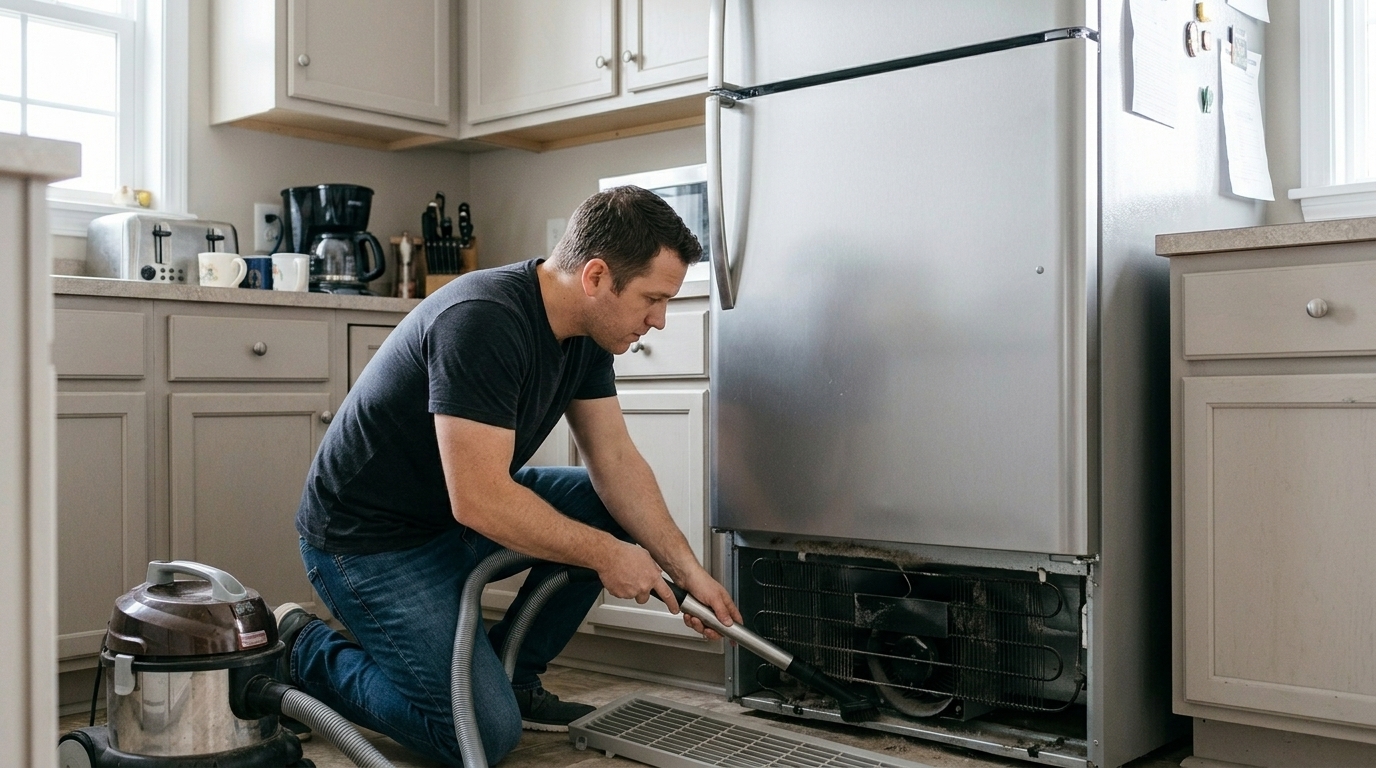
- Clean the condenser coils. Pull the fridge out carefully, remove the grille or back panel if your model allows it, and use a vacuum with a brush attachment or a coil brush. Never spray water on electrical parts.
- Listen for the fans. With the fridge plugged in again, listen near the bottom back and inside the freezer. Grinding or silence can point to a fan problem.
- Check for frost. Heavy frost on the freezer wall can mean a defrost problem.
- Watch the temperature. Place a thermometer in the fridge and check it after several hours. If it is warm or the fridge is far colder than set, a sensor or control issue may be present.
Symptom Guide: What Your Fridge May Be Telling You
| What you notice | Likely cause |
|---|---|
| Warm back or sides, dust on coils | Dirty condenser coils |
| Cold air escaping at the door | Worn gasket or door not sealing |
| Grinding or squealing near the base | Condenser fan motor |
| Heavy frost in the freezer | Defrost failure |
| Warm spots, quiet freezer | Evaporator fan |
| Clicking, hot and never cold | Start relay or compressor |
| Runs more only in summer | Hot room or tight space |
A technician can confirm the cause with testing.
Why a Fridge That Never Shuts Off Costs You
A fridge running constantly uses more electricity than one that cycles normally. It also puts extra wear on the compressor, which is the most expensive part of the fridge. Left alone, a small problem such as a dirty coil can turn into a failed fan or a damaged compressor.
There is also a food risk. If the fridge cannot keep up, food can warm past the safe limit of 40°F. Check temperatures with a thermometer, and discard perishable food that has been above 40°F for more than two hours.
When to Call a Technician
Book a visit if:
- The fridge still runs all the time after you clean the coils and check the seals.
- You hear grinding, clicking or loud humming.
- The back or sides feel very hot.
- The fridge or freezer is not reaching a safe temperature.
- Frost builds up again after you defrost.
- You smell burning or see signs of leaking oil or water near electrical parts.
A technician can test the fans, relay, sensors and defrost parts and fix the exact cause. If you need fridge repair in Tucson, our fridge repair in Tucson team can diagnose the problem and give you a clear estimate before work starts.
Repair or Replace?
Many reasons for a fridge running constantly, such as fans, relays, sensors and seals, are repairable at a reasonable cost compared to a new unit. Replacement may make sense when the fridge is old, the compressor or sealed system has failed, or repair costs are high compared to the unit’s value. Ask your technician to explain both options.
How to Keep Your Fridge From Running Nonstop
- Clean the condenser coils a couple of times a year, and more often if you have pets.
- Leave air space around the fridge.
- Replace worn gaskets.
- Let hot food cool before you put it inside.
- Do not hold the door open while you decide what to eat.
- Keep temperature settings at the recommended levels.
- Do not ignore new noises, frost or warm spots.
Frequently Asked Questions
1. Why is my fridge running constantly?
The most common causes are dirty condenser coils, leaking door seals, failed fans and hot room conditions. Start by cleaning the coils and checking the gaskets. If the problem continues, a part such as a sensor or relay may need repair.
2. Is it normal for a fridge to run all the time?
No, but it is normal for a fridge to run often, especially in hot weather or after you add groceries. Long stretches with no rest, a very hot back panel or poor cooling are signs of a problem.
3. Can a dirty condenser coil make a fridge run nonstop?
Yes. Dust blocks heat release, so the compressor works longer to cool the fridge. Cleaning the coils is often the first and easiest fix.
4. How often should a fridge cycle on and off?
Cycles vary by model, room temperature and use. If your fridge rarely turns off and the inside is not cold, have it checked.
5. Will a fridge that never shuts off use more electricity?
Yes. Extra run time means more energy use and more wear on the compressor.
6. Can a bad door seal cause a fridge running constantly?
Yes. A leaking gasket lets warm air in, so the fridge keeps running to restore the temperature. Cleaning or replacing the seal can help.
7. Why does my fridge run constantly in summer?
Heat in the room makes it harder for the fridge to shed heat. Hot kitchens, garages and tight spaces all increase run time. Clean coils and good airflow help a lot.
8. Is a fridge running constantly a sign of a failing compressor?
It can be, but it is rarely the first cause. Check the coils, seals and fans first. If the fridge runs hot and never gets cold, a technician should test the compressor and start relay.
9. How much does fridge repair in Tucson cost?
Cost depends on the part, the model and the labor. Ask for an estimate before work begins so you can compare repair with replacement.
10. Should I unplug a fridge that will not stop running?
You can unplug it to clean the coils or check parts, but keep the door closed to hold the cold. If the fridge is not cooling at all, move perishable food to a cooler and call a technician.
Get Help With a Fridge That Will Not Stop
If your fridge is running constantly, start with the coils, the seals and the room around it. If it keeps going, schedule fridge repair in Tucson before a small problem becomes a costly one.